
By definition, all clients follow their ‘aggregate beliefs’. The reason it sometimes doesn’t look like it is that clients have conflicting beliefs, so they can operate contrary to some of their beliefs in order to follow whatever other beliefs drive them in the moment.
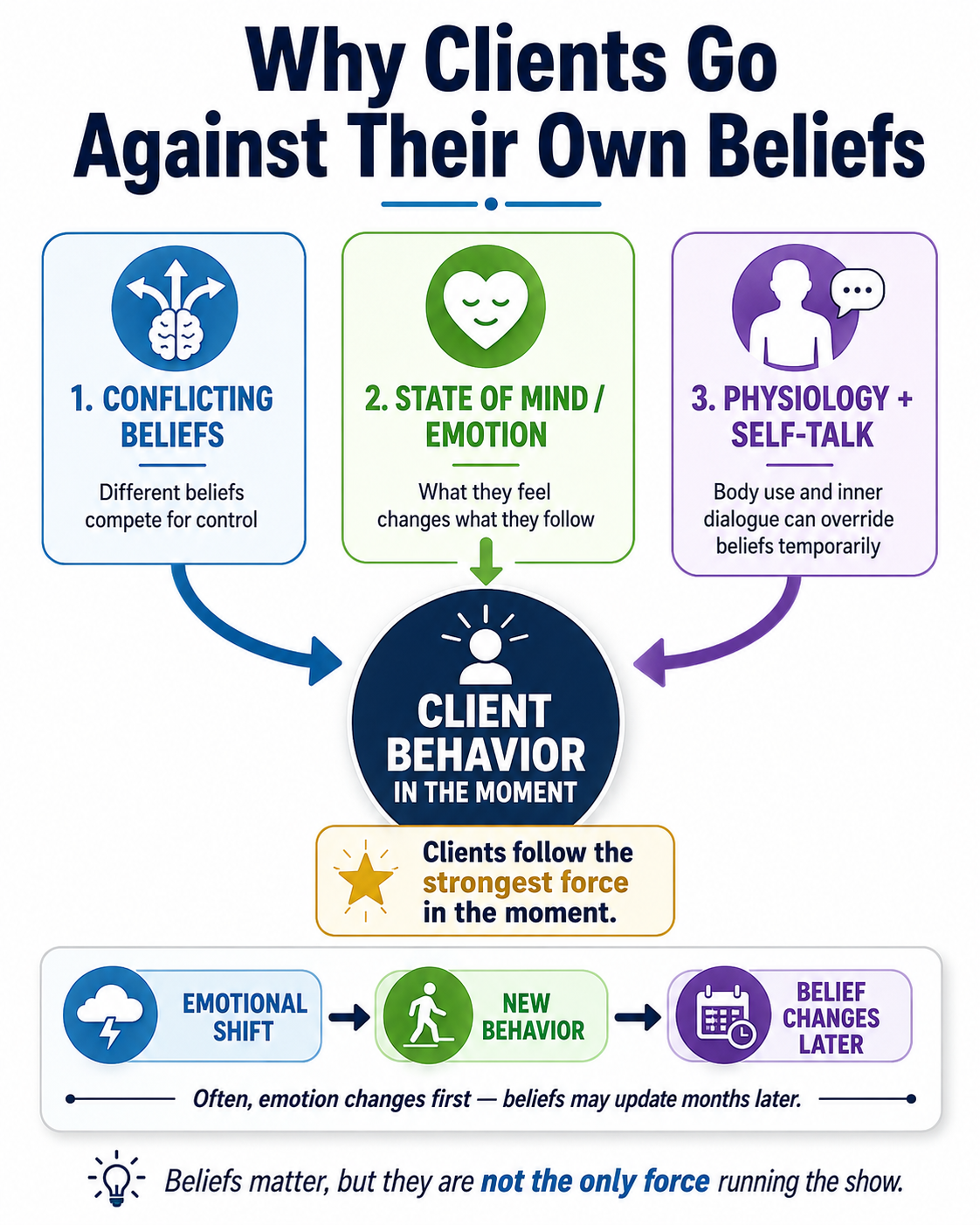
Clients will also swap the belief they ‘follow’ moment to moment depending on their state of mind.
Each state of mind is orchestrated by a belief, but is locked into a set of physiological and representational nervous system patterns (fancy terms for “body use” and “self talk”) that may override any belief temporarily. When the mood changes, the belief they follow may also change.
This is why clients may defy their beliefs temporarily because they ‘felt differently’ in the moment… casting their purported rule book aside in exchange for an emotional mandate.
Bottom line is that your client’s beliefs conduct the symphony, but they don’t write the music, and they don’t make the sounds. Belief is a powerful force, but other more powerful forces are running the show.
I find that when a client transforms, they change their emotions FIRST, and then the beliefs follow (sometimes, literally months or years later).
Sometimes, just discussing the beliefs (and their consequences) can trigger this emotional change (still before the belief itself has changed, at least consciously).
HERE’S an interactive simulations to experience the multifactorial impact of these inputs on the complex system that is “human behavioral state”:


Leave a Reply